



Knee pain can significantly affect your everyday life, making simple activities such as walking, climbing stairs, standing for long periods, or getting up from a chair increasingly difficult. When medications, physiotherapy, and other conservative treatments no longer provide sufficient relief, knee replacement surgery may be recommended by an orthopaedic specialist. So how do you choose the right place? This guide gives you 10 practical questions to ask before you book your surgery, along with what a good answer should sound like. Use it as a checklist for your consultation.
What Is Robotic Knee Replacement Surgery?
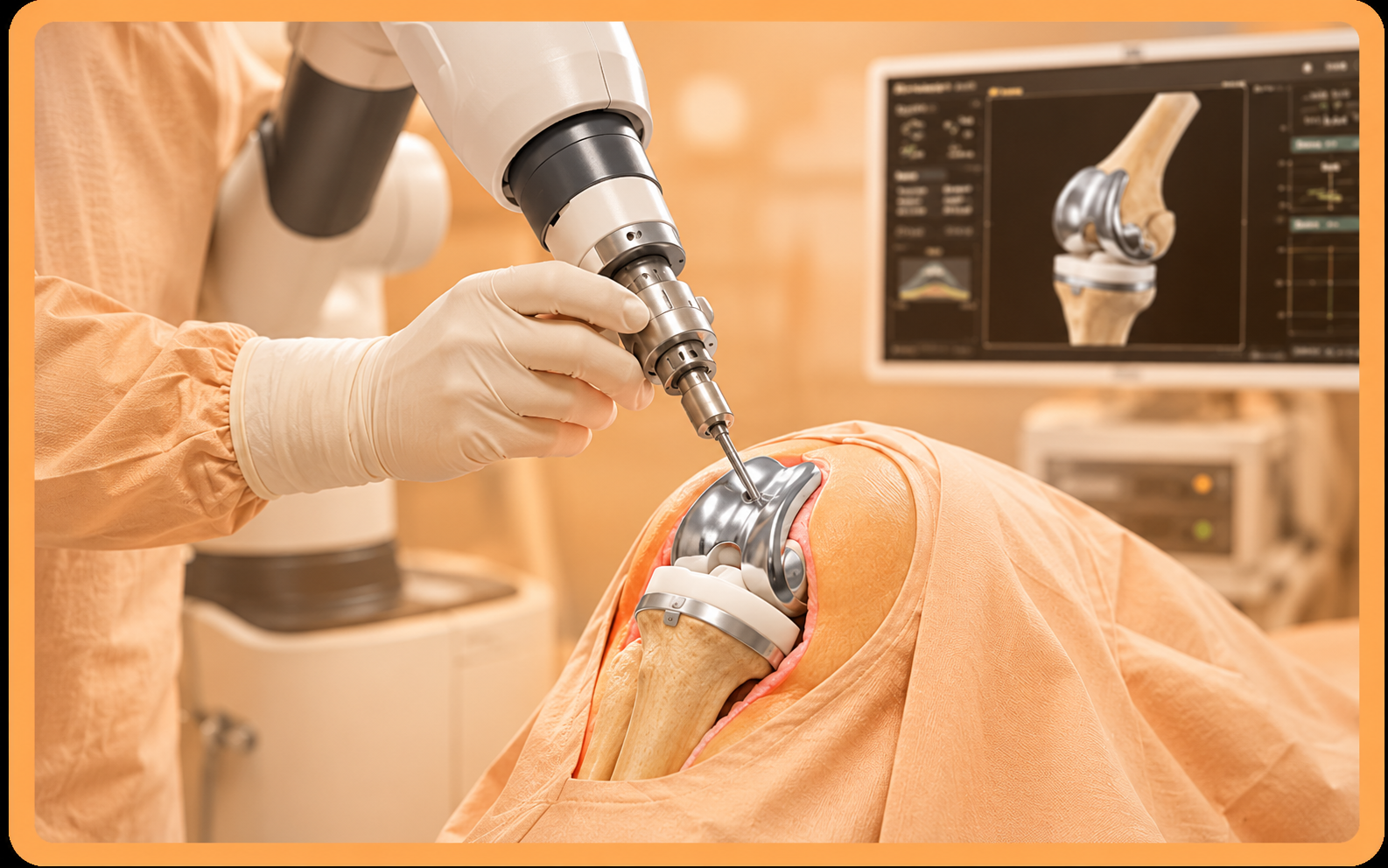
Robotic knee replacement is a form of knee replacement in which a robotic-assisted system helps the surgeon plan and carry out the operation. Using your scans and measurements, the system helps the surgeon position the implant accurately and balance the joint. The surgeon stays in full control throughout; the robot assists, it does not operate on its own.
Patients usually consider it when severe arthritis, constant pain or stiffness no longer responds to medication, physiotherapy or lifestyle changes. Hospitals offering this technology say it supports accurate implant alignment, less tissue damage and a smoother recovery. Your orthopaedic surgeon will tell you whether you are a suitable candidate.
10 Questions to Ask Before Choosing a Hospital for Robotic Knee Replacement
1. How much experience does the surgeon have with robotic knee replacement?
This is the most important question. A robot supports the surgeon; it cannot replace skill and judgment. Ask:
- How many knee replacements has the surgeon performed in total?
- How many of those were robotic-assisted?
Look for a surgeon with long, specialized experience in joint replacement and arthroscopy, and who is comfortable answering these questions openly. At Brahm Chaitanya Super Speciality Hospital in Pimpri Chinchwad, Pune for example, orthopaedic surgeon Dr. Sushil Kulkarni is listed with 25+ years of experience in joint replacement and arthroscopy.
2. Which robotic system is used, and what does it actually do?
Not all systems work the same way. Ask the hospital to explain, in plain language:
- How the system plans your surgery (for example, using scans or measurements)
- How it helps with implant positioning and joint balance
- Whether the surgeon controls every step
A confident team will explain this simply and show you how the plan applies to your knee, not just a generic brochure.
3. Am I a good candidate, and what are my alternatives?
A trustworthy hospital will not push surgery as the only option. Before recommending replacement, your surgeon should examine you, review your X-rays and ask what treatments you have already tried. Ask:
- Could physiotherapy, medication or injections help for now?
- Do I need a total or a partial knee replacement?
- Do my age, weight, diabetes or heart health change the plan?
A candid conversation here is a strong sign of ethical care.
4. Is the hospital accredited and equipped for safe surgery?
Knee replacement is a major planned surgery, so infection control and safety standards matter. Check for:
- NABH accreditation, which indicates the hospital follows recognised patient-safety and quality protocols
- Modern modular operation theatres with laminar airflow, which help keep the surgical environment clean
- In-house X-ray and imaging so your diagnosis and planning are not delayed
Brahm Chaitanya Hospital is NABH accredited and describes its modular OTs as laminar-airflow theatres designed to reduce cross-contamination risk. Always ask to see the facility before you decide.
5. Which implants will be used, and how long are they expected to last?
The implant stays in your body for years, so do not hesitate to ask about it:
- Which brand and type of implant is recommended for me?
- What material is it made of?
- What is its expected lifespan for someone with my age and activity level?
- Are there different implant options at different price points?
A good surgeon will explain why a particular implant suits you rather than simply quoting a package.
6. What are the risks, and how does the hospital handle complications?
Every surgery carries risks, including infection, blood clots, stiffness and, rarely, implant problems. Ask the team:
- What are the main risks in my specific case?
- What steps does the hospital take to prevent infection and clots?
- What happens if something goes wrong after surgery?
7. What is the full cost, and what does it include?
Cost is a real concern for most families. Ask for a estimate that clearly states what is covered:
- Surgeon and anaesthesia fees
- Implant cost
- Operation theatre and room charges
- Medicines, tests and physiotherapy
- Follow-up visits
Also ask about cashless insurance, TPA support, CGHS/ECHS acceptance and EMI options. Brahm Chaitanya Hospital lists cashless admission for insured patients, a mediclaim help desk and EMI-based financing for uninsured patients. Confirm your own policy coverage before admission to avoid surprises.
8. What does the rehabilitation plan look like?
Surgery is only half the journey. Your recovery depends heavily on physiotherapy and follow-up. Ask:
- When will I be helped to stand and walk after surgery?
- Is there an in-house physiotherapy team?
- Is home care or home physiotherapy available after discharge?
Many patients are guided to start walking within 24 to 48 hours after robotic knee replacement, though recovery varies from person to person. A hospital with dedicated rehabilitation and post-surgery home care support makes this phase far easier.
9. Does the hospital have strong medical backup and emergency support?
Knee replacement patients are often older and may also live with diabetes, high blood pressure or heart conditions. A multispeciality hospital can manage these needs under one roof. Check for:
- ICU and critical care facilities
- Cardiology and anaesthesia support
- A 24/7 emergency team
Brahm Chaitanya Hospital reports a 60-bed facility with a 14-bed ICU, a Cath Lab and 24/7 emergency care, which means you are not transferred elsewhere if a medical complication arises.
10. What do follow-up care and patient feedback look like?
A good hospital stays with you long after discharge. Ask:
- How many follow-up visits are planned, and when?
- Who do I call if I have pain, swelling or fever at home?
- Check previous patients verified reviews?
Check independent reviews, but read them with care. Look for consistent comments about communication, cleanliness, staff behaviour and recovery support rather than relying on a single glowing review.
Quick Checklist: Choosing a Robotic Knee Replacement Hospital
| What to check | What a good answer looks like |
|---|---|
| Surgeon experience | Long joint replacement experience; clear number of robotic cases |
| Technology | Simple explanation; surgeon stays in control |
| Candidacy | Alternatives discussed honestly before surgery |
| Safety | NABH accreditation; modern, clean operation theatres |
| Implants | Clear reasons for the chosen implant and its lifespan |
| Risks | Open discussion; no guarantees or exaggerated promises |
| Cost | Written, itemised estimate; insurance and EMI support |
| Rehabilitation | In-house physiotherapy and home care options |
| Backup | ICU, cardiology and 24/7 emergency available |
| Follow-up | Defined review schedule and easy access to the team |
A Balanced View: Is Robotic Always Better?
Robotic-assisted surgery is a valuable tool, and many patients and surgeons appreciate the precision it offers. At the same time, research on long-term differences between robotic and conventional knee replacement is still developing, and outcomes depend heavily on surgeon skill, patient health and rehabilitation. The best approach is to choose a surgeon and hospital you trust, then ask whether robotic assistance is the right fit for your knee.
Considering Robotic Knee Replacement in Pimpri Chinchwad (PCMC)?
If you live in Pimpri, Chinchwad, Akurdi, Nigdi or Dehu Road, you can compare these 10 points at Brahm Chaitanya Super Speciality Hospital, located opposite Tata Motors in Chinchwad. The hospital offers robotic knee replacement under its orthopaedic and joint replacement department, supported by NABH accreditation, in-house diagnostics, physiotherapy, cashless insurance and 24/7 emergency care.
Book a consultation: +91 99225 53333
Address: Station Road, near Ramkrishna More Sabhagruha, opp. Tata Motors, Bhoir Colony, Chinchwad, PCMC — 411033